






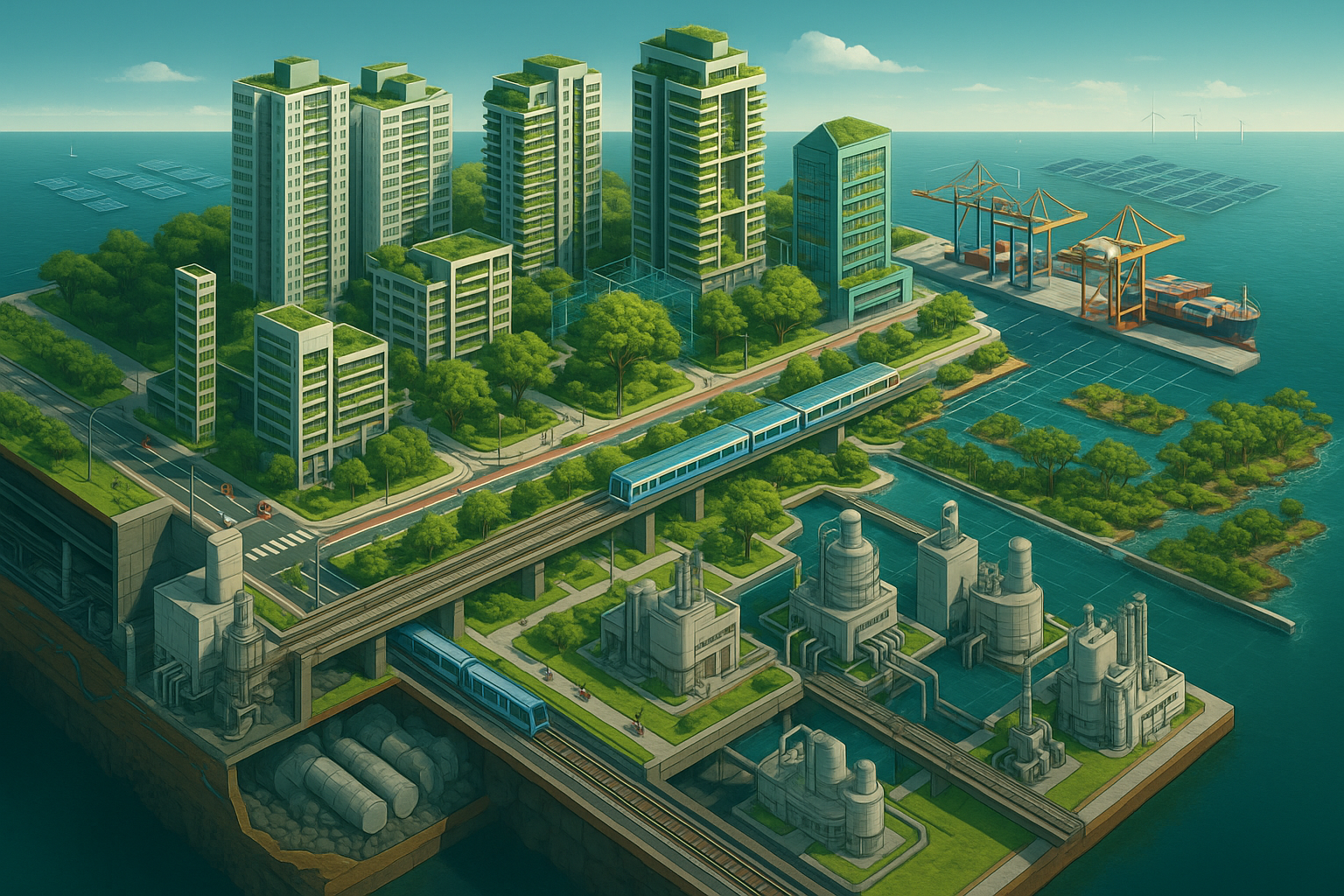
Singapore’s biggest development challenge is deceptively simple: there is not much land, and even fewer natural resources to exploit. This scarcity, however, has shaped a governance model that treats space like a priceless asset and waste like untapped value. Urban planners layer functions vertically and underground, push infrastructure to the island’s edges, and constantly re-ask what deserves to be at ground level. The result is a high-resolution land-use plan where housing, transport, industry, and nature are negotiated parcel by parcel. Scarcity is no mere constraint; it is the central design brief.
Land intensity begins with density done well. High-rise public housing delivers proximity to transport, jobs, and schools while safeguarding room for parks and community spaces. Mixed-use zoning reduces travel demand, while car-lite policies reserve scarce road space for essential movement. Underground caverns store hydrocarbons and utilities, surface ports consolidate to free waterfronts, and data centers are nudged toward higher efficiency. Each decision wrestles with trade-offs: a hectare preserved for mangroves is a hectare not available for factories, yet ecological buffers shield coastlines, cool neighborhoods, and sustain biodiversity.
Natural resource constraints force technological imagination, especially in water and energy. Decades of investment in recycled water and desalination complement catchment management, creating diversified supply that holds during prolonged dry spells. On energy, the island’s solar potential is real but limited by cloud cover and roof area, prompting experiments with sea-based arrays, demand response, and regional interconnectors. Circular economy policies seek to turn waste into feedstock, easing import dependence while trimming emissions. Even food is being rethought through urban farms, controlled-environment agriculture, and modest self-production targets.
Infrastructure sequencing is as important as engineering. When ports move, entire districts can be remade; when rail lines extend, residential intensification follows; when power grids modernize, industrial estates can adopt electrified processes. Master planning agencies coordinate these moves on multi-decade horizons, updating plot ratios, relocating incompatible uses, and preserving corridors for future lines. Digital twins, scenario tools, and rigorous consultation reduce risk in a context where a mistake consumes an irreplaceable slice of land.
Climate change magnifies every pressure. Sea-level rise, extreme rain, and heat challenge drainage, coastal defenses, and public health. Higher ground is scarce; defenses must be smart, layered, and nature-positive wherever feasible. Singapore’s response is pragmatic: pilot, measure, scale. The bigger story is that limits have not shrunk ambition, they have sharpened it—pushing the city toward compactness, clean technology, and systems that prize resilience over sprawl.