



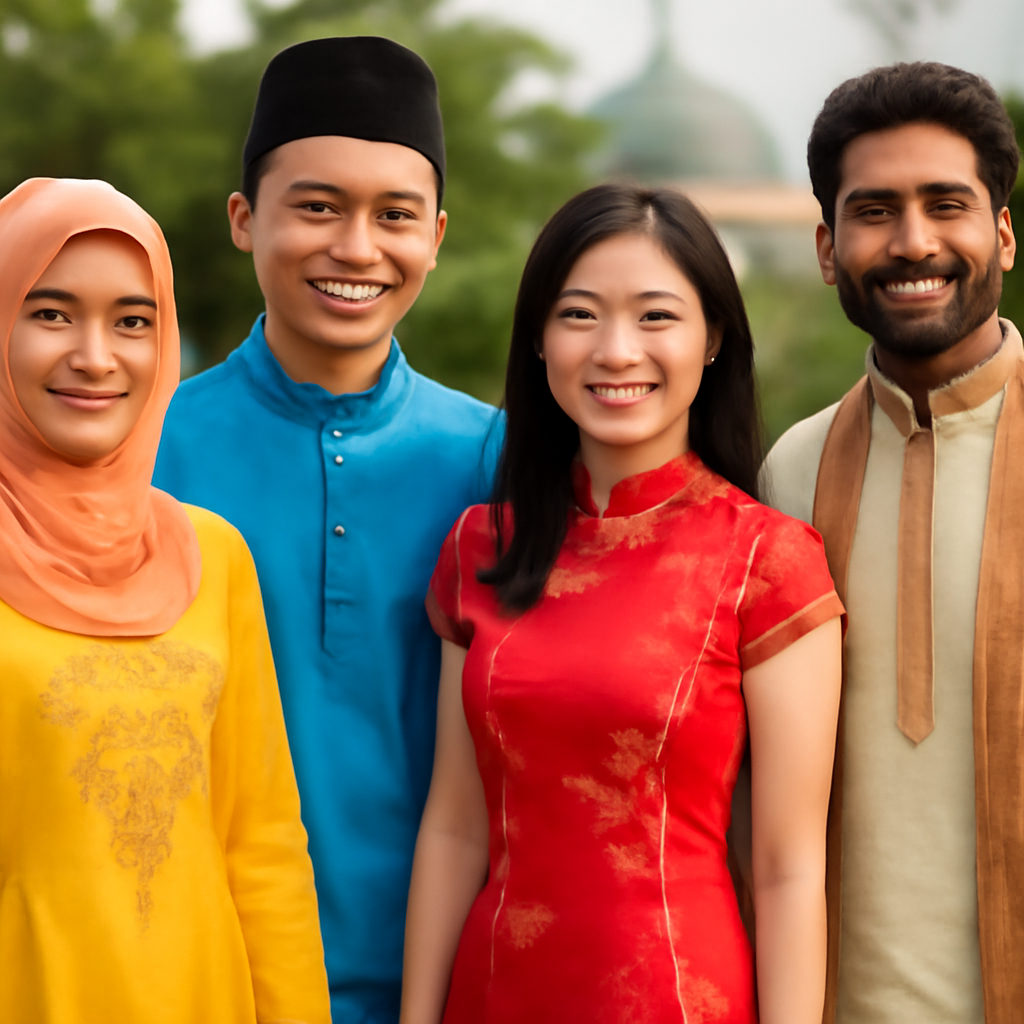
Malaysia is a country renowned for its extraordinary cultural, ethnic, and religious diversity. Situated in Southeast Asia, this country is home to various ethnic groups, each with its unique traditions, languages, and beliefs. Despite the noticeable differences among its people, Malaysia has managed to create harmony through acceptance, mutual respect, and the recognition of the importance of diversity in daily life.
The major ethnic groups in Malaysia are Malays, Chinese, and Indians. Each group brings a rich and unique heritage. The Malays, the largest group, are known for their deep-rooted Islamic traditions and strong cultural practices in arts, music, and dance, such as Dikir Barat and Zapin. Meanwhile, the Chinese community, mostly practicing Buddhism and Taoism, contributes to the richness of the country with traditional arts like calligraphy, music, and celebrations like Chinese New Year. On the other hand, the Indian community in Malaysia, predominantly Hindu, brings traditions with festivals like Deepavali and classical dance and music performances.
Cultural diversity in Malaysia is not just reflected in ethnicity, but also in aspects such as food, clothing, language, and arts. One prominent example is Malaysian cuisine, which is a blend of Malay, Chinese, and Indian influences. Dishes like nasi lemak, rendang, dim sum, roti canai, and teh tarik are symbols of the harmonious fusion of cultures. These dishes are not only delicious but also represent the way different traditions come together.
Traditional clothing in Malaysia is equally diverse, with the Malay traditional attire of Baju Kurung and Baju Melayu, the Chinese Cheongsam and Samfu, and the Indian Saree and Dhoti. Additionally, indigenous groups such as the Orang Asli have their own traditional garments, further enriching Malaysia’s cultural tapestry. Every piece of traditional clothing holds symbolic meaning, reflecting social and spiritual values.
The Malay language serves as the official language of the nation, but Malaysia is home to more than 130 languages and dialects, including Mandarin, Tamil, Hokkien, Cantonese, and various indigenous languages. This multilingual environment plays a significant role in uniting people while celebrating the diversity of language. In daily life, many Malaysians speak “rojak” — a blend of different languages — showcasing how flexible and culturally inclusive the society is.
What is most impressive is how Malaysians live harmoniously, despite these apparent differences. Malaysia prides itself on its ethnic diversity, reflected in its policies, education, and social frameworks that emphasize respect and understanding between its people. The “1Malaysia” concept introduced by former Prime Minister Najib Razak is an example of the effort to foster unity while celebrating diversity.
In conclusion, Malaysia’s cultural diversity is one of its greatest assets. Not only does it enrich the nation’s tourism and economy, but it also strengthens national pride. By respecting and celebrating differences, Malaysia proves that diversity is not a barrier, but a force that unites the nation.